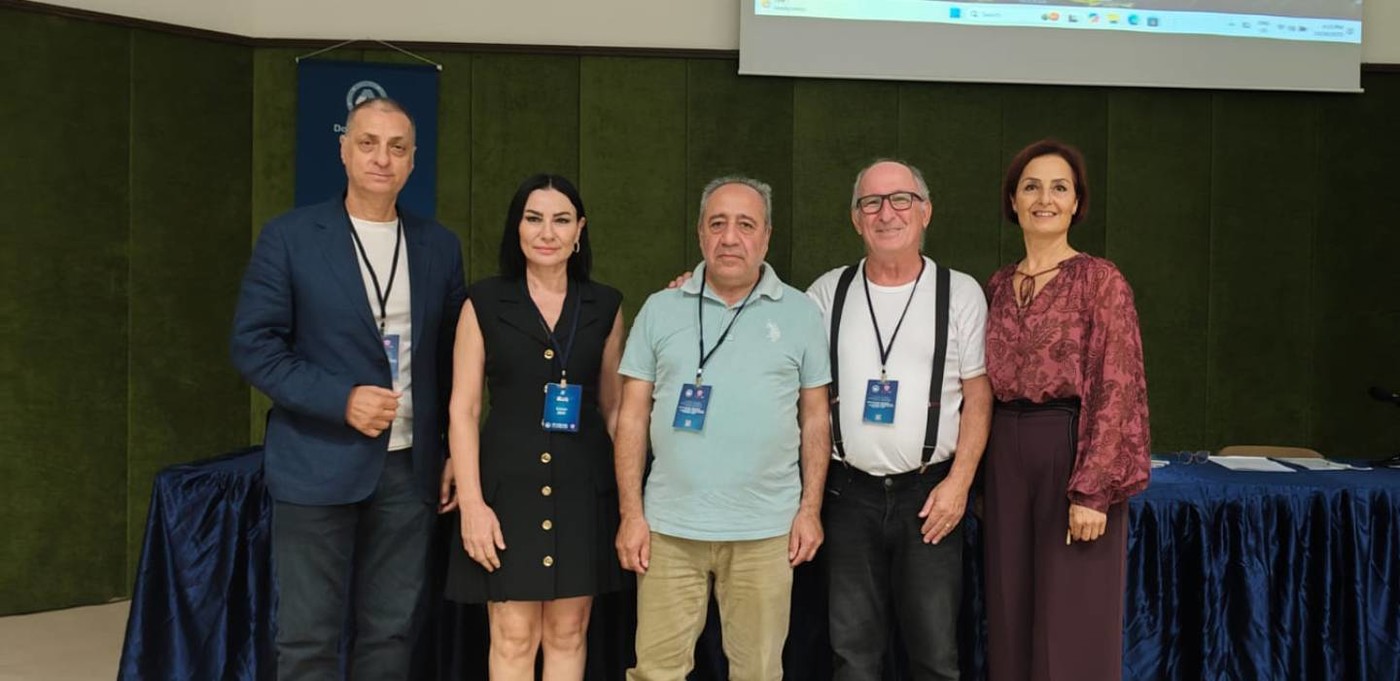
“Basic Education Curricula in the context of Educating 21st Century Individuals in the Turkish Republic of Northern Cyprus” panel was held as part of the 13th International Congress on Curriculum and Instruction (EPOK) hosted by Eastern Mediterranean University (EMU). Prof. Dr. Ahmet Pehlivan, Co-chair of Congress Organizing Committee and Dean of EMU Faculty of Education moderated the event.
The panel event featured EMU Faculty of Education, Educational Sciences Department Head Prof. Dr. Canan Zeki and academic staff member of said department Prof. Dr. Sıtkıye Kuter, Prof. Dr. Osman Cankoy from METU North Campus and, Prof. Dr. Müfit Kömleksiz from European University of Lefke as panellists.
Prof. Dr. Canan Zeki approached the basic education programs in TRNC in relation to the needs of Z and Alpha generations. Pointing out the learning styles of Gen Z, Prof. Dr. Zeki emphasized that the flexible structure of the elementary education programs aligns well with the needs of this generation; however, she underscored the necessity of training teachers in a way that equips them to meet children’s learning requirements.
Furthermore, Prof. Dr. Sıtkıye Kuter evaluated the elementary education programs through the lens of critical global citizenship. She observed that while the programs generally address democratic competencies, these themes that are central to humanity, should be linked to global challenges with a more critical and pluralistic perspective.
Prof. Dr. Osman Cankoy examined the effectiveness of the elementary mathematics curriculum in fostering 21st-century skills. He stated that although the curriculum is well-designed to promote these competencies, they are not sufficiently implemented in practice. Prof. Dr. Cankoy noted that the primary reason for this gap is the test-oriented nature of centralized examinations.
Lastly, Prof. Dr. Müfit Kömleksiz underscored that the basic education programs constitute a pivotal milestone in the history of Turkish Cypriot education. He asserted that, for these programs to be implemented effectively, the organizational structure of the TRNC Ministry of Education must be brought into alignment with the program’s requirements, and that the curricula of EMU and the Atatürk Teacher Training Academy should be coordinated accordingly. Prof. Dr. Kömleksiz further highlighted the crucial role of cooperation between academic institutions and policymakers in Cyprus.