
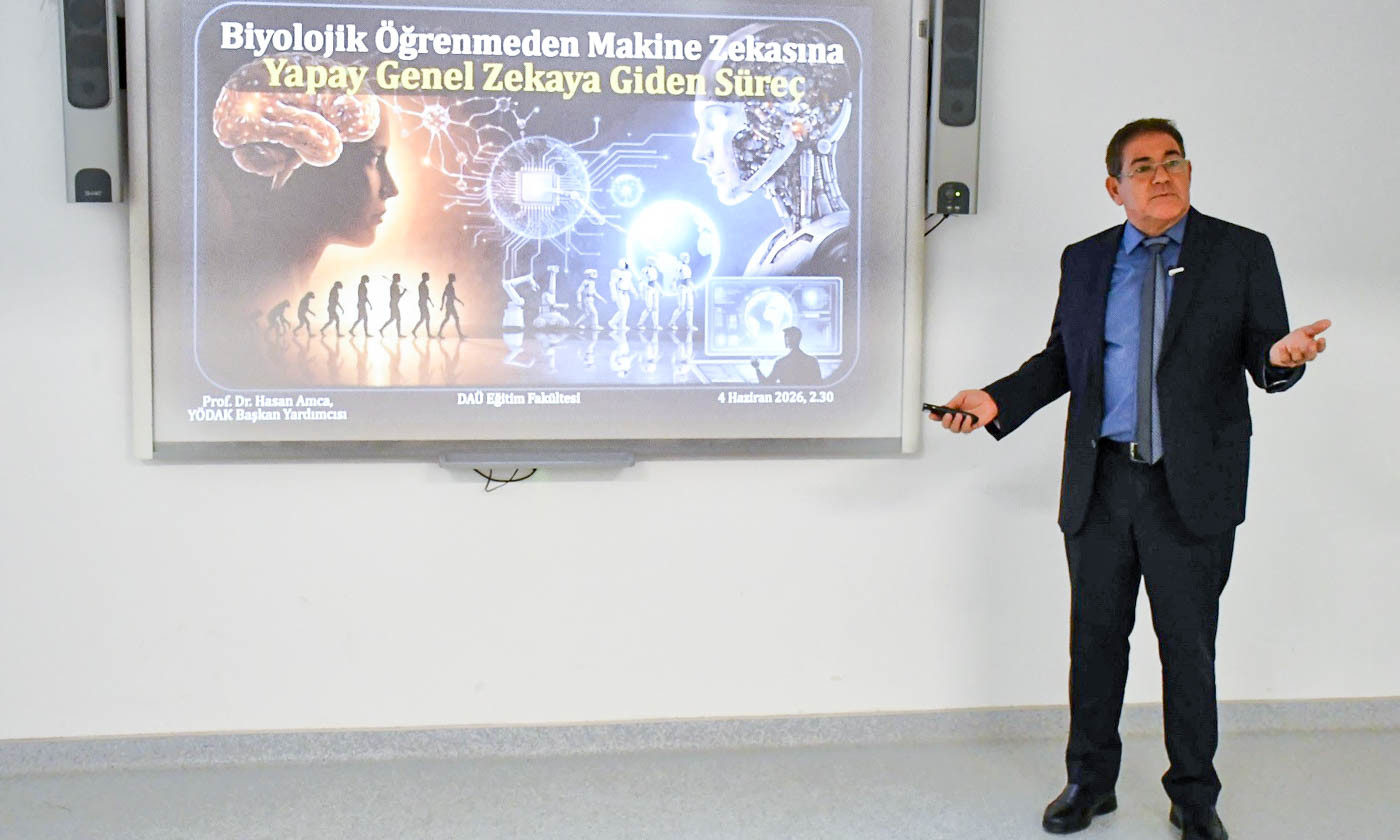
Eastern Mediterranean University (EMU), Faculty of Education hosted a very meaningful scientific event titled “Biyolojik Öğrenmeden Makine Zekâsına: Yapay Genel Zekâya Giden Rota / From Biological Learning to Machine Intelligence: Route to Artificial General Intelligence” which was held at Assist. Prof. Dr. Ali Hikmet Civelek Conference Hall. Featuring Prof. Dr. Hasan Amca, Vice Chair of the Higher Education Planning, Accreditation and Coordination Council (YÖDAK), as a guest speaker, the seminar comprehensively explored the evolution from biological learning processes to modern machine intelligence, as well as the future development trajectory of artificial general intelligence.
Prof. Dr. Ahmet Pehlivan, Dean of EMU Faculty of Education; Prof. Dr. Ali Hakan Ulusoy, Director of EMU Institute of Graduate Studies and Research; Assist. Prof. Dr. Fatoş Erozan, Vice Dean of EMU Faculty of Education, department chairs, faculty members and students attended the event.
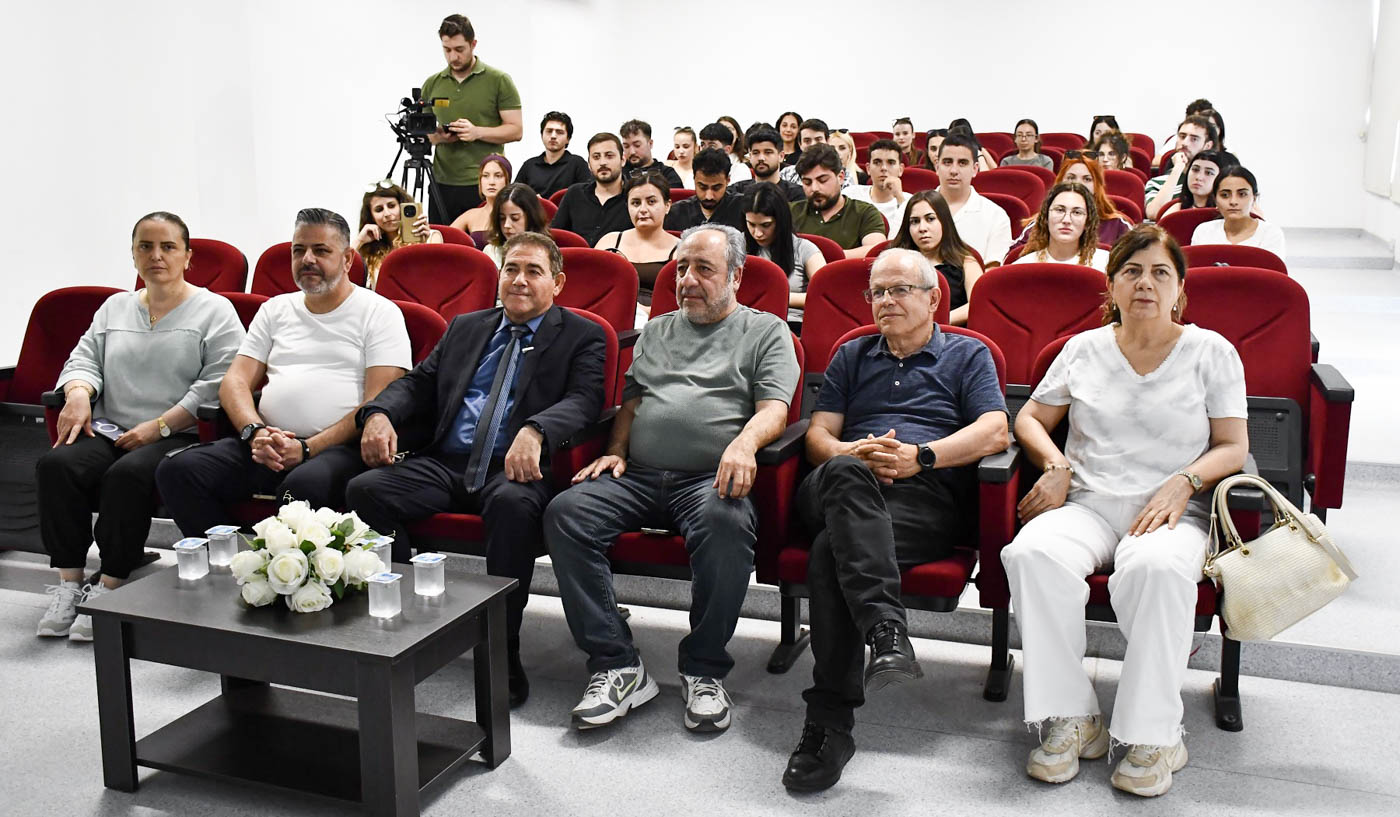
Future of Artificial Intelligence Discussed
During the seminar, Prof. Dr. Hasan Amca, Vice Chair of the Higher Education Planning, Accreditation and Coordination Council (YÖDAK), addressed the differences between artificial intelligence and human learning, as well as the multidimensional nature of the learning process. It was emphasized that learning cannot be reduced to a single characteristic; rather, in humans, the learning process is shaped by value judgments, cultural differences, and ethical considerations. The seminar further highlighted that the fundamental elements distinguishing the human mind from machines include reasoning abilities—such as the capacity to discern good from bad and right from wrong—and the decisions made based on such judgments. Attention was also drawn to the influence of human values, including freedom, love, and hope, on learning and behavior.
In addition, the learning capacity of artificial intelligence systems was examined from a data-driven and algorithmic perspective, distinguishing it from the way humans learn. Within this context, the discussion also addressed the fact that artificial intelligence can occasionally generate misleading outputs or produce inaccurate content, commonly referred to as “hallucinations”. Furthermore, participants explored the influence of culture on the learning process, the ability of individuals to develop different value systems in different environments, and the implications of these differences for both human learning and artificial intelligence.
The seminar also addressed the evolutionary and emotional dimensions of human learning, during which differing perspectives were presented on whether emotions and concepts such as love can be learned. Conducted in an interactive format, the seminar explored the nature of learning, the boundaries between humans and machines, and the extent to which artificial intelligence may approach these uniquely human characteristics in the future.