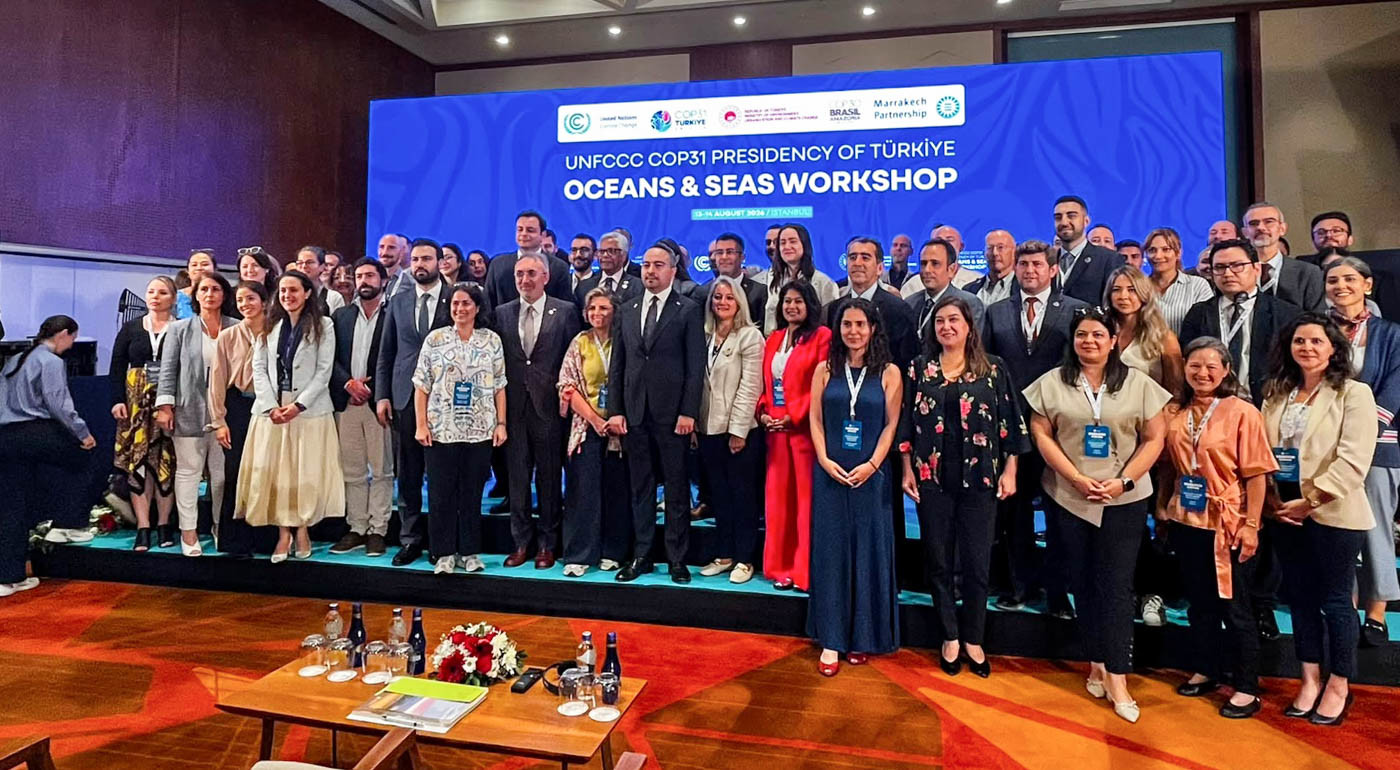
Eastern Mediterranean University (EMU) participated in the workshop titled “UNFCCC COP31 Presidency of Türkiye – Oceans & Seas Action Agenda Workshop”, held in Istanbul on 13–14 August 2026 as part of the preparations for the 31st Conference of the Parties to the United Nations Framework Convention on Climate Change (COP31), one of the world’s most prominent international platforms in the fight against global climate change. At the workshop, organized within the framework of the COP31 “Oceans and Seas Action Agenda”, EMU was represented by Assist. Prof. Dr. Burak Ali Çiçek, Member of the COP31 Process Advisory Board, Chair of the EMU Faculty of Arts and Sciences, Department of Biological Sciences, and President of the Underwater Research and Imaging Center (SAGEM).
Organized by the COP31 Presidency of Türkiye, the two-day workshop brought together representatives of national and international organizations, scientists and various stakeholders to discuss the priorities of the ocean and climate agenda within the COP31 process, as well as practical and actionable solutions.
COP31 to Take Place in Antalya, 9–20 November
Held annually under the United Nations Framework Convention on Climate Change and regarded as the world’s foremost climate summit, COP31 will take place in Antalya, Türkiye, from 9 to 20 November 2026. The summit will serve as a major global gathering where the international community will address future policies and concrete implementation measures, particularly in the areas of climate change adaptation, climate finance and sustainable development. At the summit, EMU aims to bring its expertise and knowledge to Antalya through a delegation led by Assist. Prof. Dr. Burak Ali Çiçek, Member of the COP31 Process Advisory Board, Chair of the EMU Faculty of Arts and Sciences, Department of Biological Sciences, and President of the Underwater Research and Imaging Center (SAGEM).
“Seas and Oceans Are at the Heart of Climate Action”
Commenting on the matter, Assist. Prof. Dr. Çiçek stated: “Covering a large proportion of the Earth’s surface, seas and oceans play a critical role in regulating the climate system and sequestering carbon from the atmosphere. At the same time, rising sea temperatures, sea-level rise, ocean acidification, oxygen loss and extreme weather events associated with climate change are placing increasing pressure on marine biodiversity, coastal ecosystems and communities that depend on these systems.
For this reason, the protection of seas and oceans is regarded not merely as an environmental policy aimed at conserving biodiversity, but as one of the fundamental components of global efforts to combat and adapt to climate change. In particular, the protection and restoration of blue carbon ecosystems, marine renewable energy, sustainable maritime activities, the reduction of marine pollution and the development of climate-resilient coastal areas are becoming increasingly important elements of climate action.
In line with this approach, the two-day workshop held in Istanbul addressed a wide range of topics, including blue carbon and the protection of marine ecosystems, marine renewable energy, the decarbonization of maritime transport and ports, the strengthening of regional cooperation on marine issues, marine pollution and circular solutions, data and knowledge sharing, the regenerative blue economy, and ocean and climate finance. One of the key areas of focus at the workshop was the translation of scientific and technical studies into practical applications. Discussions focused on transforming solutions developed in the fields of oceans and climate into concrete projects and measurable outcomes, strengthening regional and international cooperation, expanding financing opportunities, and establishing implementation mechanisms that will remain in place beyond COP31.”
EMU Brings Its Scientific Expertise to the COP31 Process
The Eastern Mediterranean is among the regions where the impacts of climate change are being felt particularly strongly. Rising sea temperatures, changes in biodiversity, the spread of non-native and invasive species, increasing pressures on coastal habitats and changes in marine ecosystems are heightening the region’s vulnerability to climate change. In this context, long-term scientific studies conducted on marine ecosystems in and around Cyprus are important not only at the local level, but also for understanding how the Eastern Mediterranean is responding to climate change.
EMU continues to make scientific contributions to this process through its research and extensive field experience in areas including marine and coastal ecosystems, marine biodiversity, the conservation and restoration of seagrass meadows, wetlands, water quality, nature-based solutions, and strengthening ecosystem resilience to climate change.
The COP31 process also provides an important opportunity to bring EMU’s expertise in these fields to the international climate agenda and, in particular, to raise international awareness of the challenges facing the Eastern Mediterranean and island ecosystems, as well as the nature-based solutions that can be developed to address them.
As preparations for COP31 continue, with a focus on recognizing seas and oceans as an integral part of climate action and translating scientific knowledge into actionable policies, EMU will continue to contribute to the process through its academic expertise, research infrastructure and field experience in the Eastern Mediterranean.